Corporate Law
Production Fee
What is meant by production fees imposed by the General Customs Authority / Tax Department?
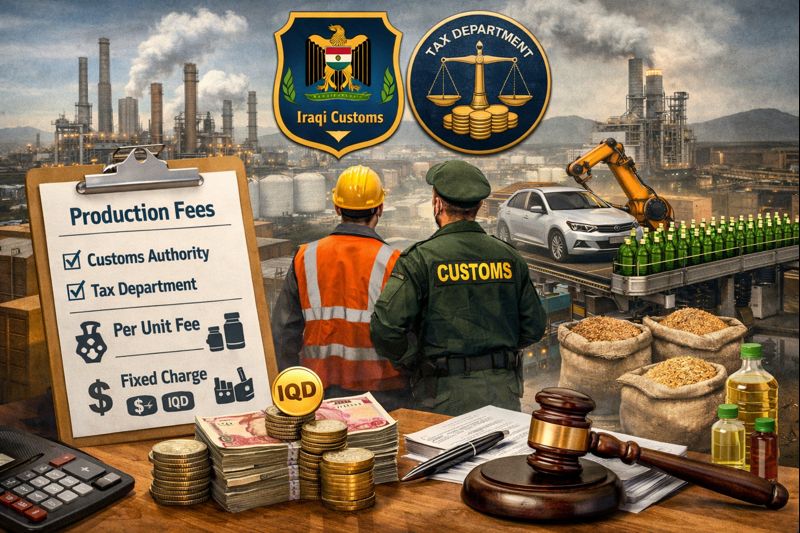
Production Fee
A production fee is a monetary amount imposed by the state on goods produced domestically at the stage of production or circulation. It is considered one of the non-tax fees, and it is usually intended to:
- Regulate industrial and commercial activities
- Finance regulatory or sector-specific authorities
- Impose a cost on the production of certain goods
Production fees are mentioned in the Iraqi Industrial Investment Law No. (20) of 1998, where the term “production fee” appears as a type of sectoral fee imposed on industrial producers. Such fees are typically imposed in one of the following forms:
- A fee paid by the industrial establishment for each unit of production, such as:
a fee per ton, meter, liter, piece, etc. - A lump-sum amount in return for the right to produce or operate, such as:
quarry fees, production fees on beverages, or fees imposed on certain agricultural and industrial products.
Important Note:
The production fee is not an income tax, and it is not determined by the Investment Law itself.
- Rather, it is a fee imposed under sector-specific laws or instructions issued by bodies such as the Ministry of Industry, the Ministry of Finance, or the competent sectoral authority responsible for production.
- Since these fees vary by sector, the Investment Law does not specify their amounts; it merely refers to them as an exception to investment exemptions, in accordance with Article (8) of the Iraqi Investment Law No. (20) of 1998.
Typically, companies engaged in the following industries are subject to production fees:
- Petroleum products
- Vegetable oils
- Lighting equipment
- Automotive manufacturing
- Cigarettes and tobacco products
- Electronic industries
- Pharmaceutical manufacturing
- Local sugar production
- Alcoholic beverages
- Food industries
- Cement
- Light industries
- Soft drinks
Simplified Summary
A production fee is a government-imposed charge levied on an industrial product at the stage of production. Its amount varies depending on the type of industry and the applicable regulatory legislation. There is no single unified rate prescribed by law; rather, it is calculated in accordance with the instructions issued by the Customs Directorate / Production Tax Department.
Author

Ayman Khalid Abdul Hamid
Director & Litigation Lead
Leads the litigation department with extensive experience in civil, commercial, and labor cases across all Iraqi court levels.